An explanation of the project, and how these devlogs will work.
What’s Sunny Sanbot?
This is a project I started in Summer 2025, with the main goal to upgrade my Sanbot Elf S1-B2 humanoid robot to be able to navigate and do tasks for me using AI. The name of the project was inspired by the TV show Sunny on Apple TV, in which there is a humanoid robot called Sunny who is able to carry out tasks and do anything the owner asks. That became the aspiration for Sanbot, and so I named the project after it.
The robot itself is one developed by the company Qihan, based in China. There are multiple models, including the Nano, the Max, and the King Kong - the Elf is the flagship model, with Qihan claiming 60,000 sales, a massive figure. This is much more than the common alternative, the Pepper robot, that hit 27,000 units globally. Sanbots are still deployed in different industries today, including advertising in stores, digital concierge work at hotels, schools, hospitals, airports, and customs checkpoints. Having this robot for myself is quite a privilege, and gives me a great sandbox for my project.
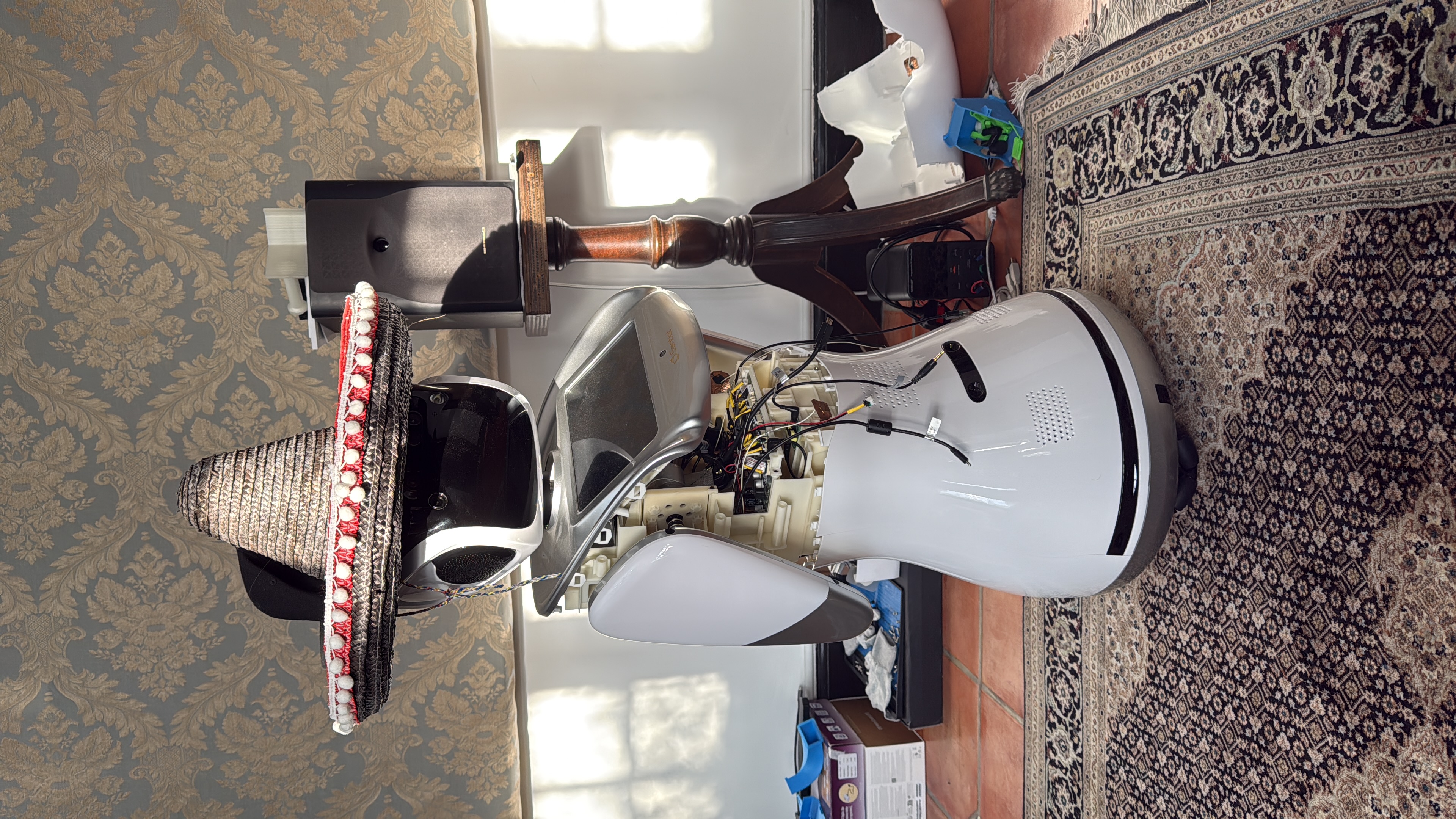
It’s not perfect though - whilst there is a great SDK provided, I wanted to make Sanbot more powerful, and that would require swapping out the main control board for something more capable. Unfortunately, the inner workings of the robot are completely closed source - no schematics or source code - so I’ve had to reverse engineer everything before I could even start with the AI. This makes it a very fun project (which is still ongoing as I write this).
What am I doing with it?
My plan is to replace the old Android board with my own Raspberry Pi 5 to control it all. The Pi has 16GB of RAM and a 26 TOPS AI HAT+, giving me enough compute to run small local LLMs and do on-board computer vision. I also hope to run larger models on servers, either off-site or at home (if it’s cost-effective).
Then I’ll develop autonomous navigation and obstacle avoidance, so Sanbot can navigate anywhere on the ground floor of my house, even if furniture or obstacles have moved. I’ll also (try to) make a system that can estimate where my voice is coming from and navigate to me, so Sanbot could travel from my music studio to my living room when I call it.
I’ve not planned so much after that. I may expand the platform to allow Sanbot to do more general tasks beyond talking and walking. Perhaps I’ll build more capable hands so it can vacuum my house, or get me water. Maybe some way for it to climb the stairs, so it can automate multi-bed prints for me. The only limits are my time, determination, and financial status. We’ll see how quickly those run out.
These devlogs
I am writing this first devlog in June 2026, and as you can tell, that’s a long time after this project started. I’ll try to give a vague timeline on when things happened as I write about them, but I haven’t documented much so far, beyond some screen recordings and short explanation videos, which I intend to use to make a YouTube video series at some point.
I’ll start from the beginning in 0x01, and slowly try to catch up to the present time. Most of the work so far has been reverse engineering and programming, so you’ve got that to look forward to. At present, I’m designing mounts for some hardware and preparing to start the AI work, so that’ll be coming in a bit too.
I’m not writing this for anyone in particular, but rather for documentation and to share this with the people of the internet. If you do find this interesting, I’d be happy for you to read along with this journey. Perhaps I’ll add a comment section for each devlog, so you can leave comments or advice. You can also follow my work on my GitHub, @KitcatCatlord, which is where I post all of my code.
In 0x01, I’ll be going right back to the beginning, and explain how I started reverse engineering this closed-source Android robot, with no schematics, no source code, and almost no documentation. I hope to see you there. Until next time.
Comments
Open to load comments.